Why User Geography Decides What a Browser Extension Is Worth
Two extensions with identical install counts can differ fourfold in value. The variable that explains most of that gap is which countries the users are in, and it is measurable.
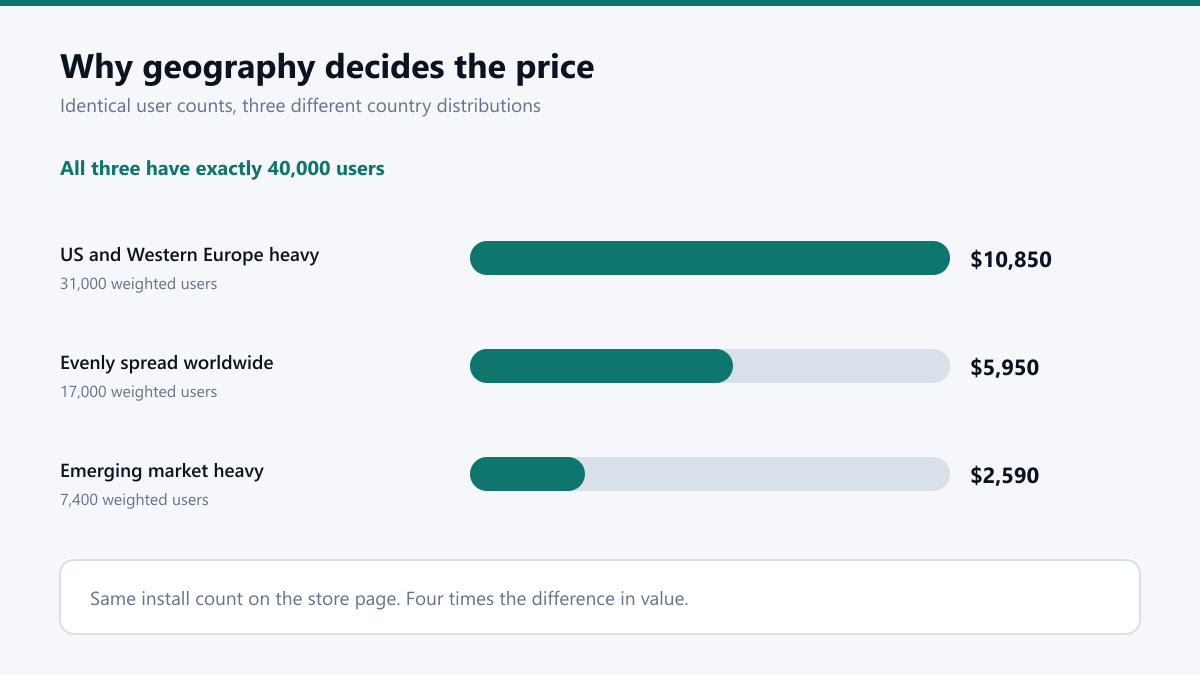
Here is a comparison worth sitting with. Two extensions, both with exactly 40,000 weekly active users, both rated 4.6, both two years old, both in the same category.
The first has 55 percent of its users in the United States, Canada and the United Kingdom. The second has 70 percent across India, Indonesia and Pakistan. Same install count on the store page. The first is worth somewhere around four times the second, and no reasonable buyer would dispute it.
This is uncomfortable to write plainly, so let me be precise about what is being claimed. This is not a statement about users as people. It is a statement about what advertisers pay, what payment infrastructure exists, and what price points a market supports. Those are commercial facts about markets, not judgements about the humans in them.
Where the difference actually comes from
Three mechanisms, all of them independent, all pushing the same direction.
Advertising rates. If the extension monetises with ads, or the buyer plans to, the revenue per thousand impressions varies by roughly an order of magnitude between the top and bottom tiers. The same user, the same engagement, a tenth of the revenue.
Payment conversion. For subscription or one-off purchase models, the gap is even wider. It is not only willingness to pay – it is whether the cards, the currencies and the checkout flows work smoothly at all. A user who wants to pay and cannot is worth the same as one who does not want to.
Acquisition cost as a proxy. The clearest signal is what it costs to acquire a user in each market through advertising. That number is public, it is set by a real market, and it maps closely to what a user is worth once acquired.
What this looks like in numbers
Take the same 40,000 users and run them through a weighting model. The install count is identical; the weighted user count is not.
| Distribution | Users | Weighted users | At 0.35 per weighted user |
|---|---|---|---|
| US and Western Europe heavy | 40,000 | ~31,000 | ~10,850 |
| Evenly spread worldwide | 40,000 | ~17,000 | ~5,950 |
| Emerging market heavy | 40,000 | ~7,400 | ~2,590 |
Four times the value, from a variable that never appears on the store listing page.
Why sellers should publish it anyway
The instinct, if your distribution is on the weaker end, is to lead with the install count and hope nobody asks. This backfires reliably.
Any buyer serious enough to actually complete a purchase will ask for the country breakdown during diligence. Discovering it late, after they have anchored on a price built from the headline number, does not make them pay more. It makes them either walk away or reprice downward with a lot less goodwill than they had at the start.
Publishing it up front does three things. It filters out buyers who were never going to complete once they saw the data. It positions the price as the conclusion of an argument rather than an opening bid. And it makes every other number on the listing more credible, because you have already shown the one that was inconvenient.
Getting the data
Every store exposes this. In the Chrome Web Store developer dashboard the country breakdown sits in the item’s statistics. Microsoft Partner Center reports it under the add-on’s analytics. Firefox exposes it in the AMO statistics dashboard, which is unusually generous – it is publicly visible for any add-on.
One caution when you export: geography reports usually cover a rolling window such as the last 30 days, while the headline install count is a lifetime or current-users figure. They will not add up, and that is expected. Use the report for the shape of the distribution and scale it against the current total rather than treating it as a second user count.
Is this not just guessing with extra steps?
The weights are a judgement, but they are a stable, disclosed judgement applied identically to every listing. That is very different from an unexplained number. A buyer who thinks a particular weight is wrong can say which one and why, which is a conversation worth having.
Can a buyer change the geography after purchase?
Slowly and expensively. Store search rankings and existing user bases have enormous inertia. Shifting the country mix means acquiring new users in the target market at market rates, which is precisely the cost the buyer was trying to avoid by purchasing an existing extension.
What about extensions with no monetisation plan at all?
Geography still matters, because the buyer is pricing what they could do later. A buyer with no route to revenue is not really a buyer. The plan may be vague, but the ceiling it implies is set by the same country distribution.
Do the weights need updating over time?
Yes, though slowly. Advertising rates and payment infrastructure shift over years, not months. Reviewing the table annually against your own completed sales is enough.
Keep reading
4 min read
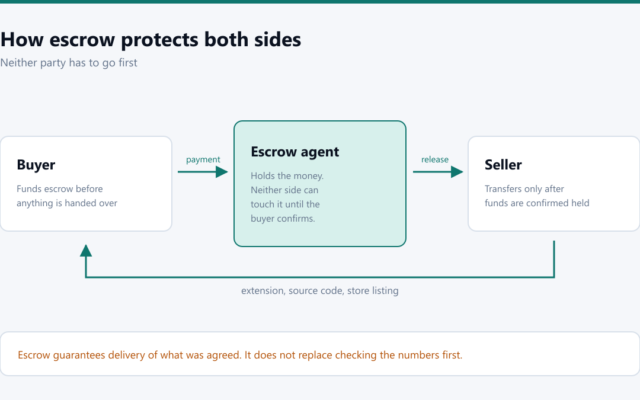
Buying a Browser Extension Safely: How Escrow Protects Both Sides
In a browser extension sale neither side can go first without exposure. Escrow removes that problem entirely, and understanding how it works is what separates a clean deal from a bad story.
5 min read
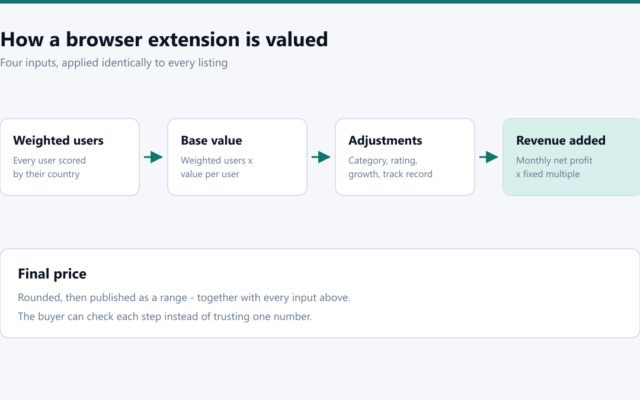
How to Value a Browser Extension: A Data-Driven Framework
Install counts alone tell you almost nothing. Here is the framework I use to value a browser extension, from weighting users by country to deciding what a revenue multiple should actually be.
4 min read
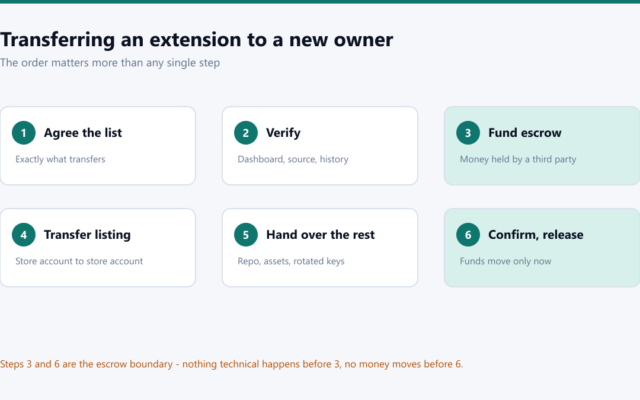
Chrome Web Store Ownership Transfer: A Step-by-Step Guide
Moving an extension to a new owner is the part of a sale that goes wrong most often. Here is the order the steps have to happen in, what breaks when you get it wrong, and how to protect both sides.