Buying a Browser Extension Safely: How Escrow Protects Both Sides
In a browser extension sale neither side can go first without exposure. Escrow removes that problem entirely, and understanding how it works is what separates a clean deal from a bad story.
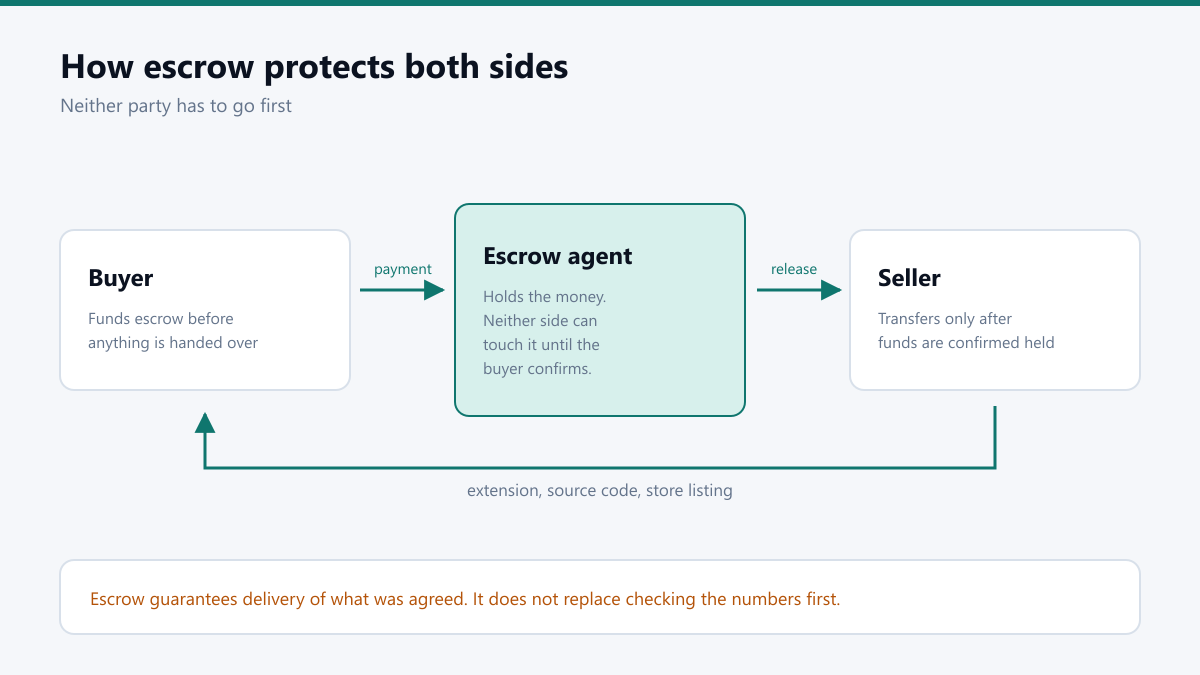
Every private sale of a digital asset runs into the same wall. The buyer will not pay before receiving anything. The seller will not hand over a store listing and a repository before being paid. Both positions are entirely reasonable, and together they are a deadlock.
Escrow exists precisely for this. A third party holds the money while the transfer happens, and releases it only when the buyer confirms the goods arrived. It is not a formality to skip when everyone seems nice – it is the mechanism that makes the deal possible at all.
How the flow actually runs
- Buyer and seller agree terms: price, what is included, and a deadline.
- The buyer funds the escrow account. The seller can see the funds are held, but cannot touch them.
- The seller performs the transfer: store listing, repository, assets, credentials.
- The buyer inspects against the agreed list, inside a defined window.
- On confirmation, escrow releases to the seller. If something is missing, the clock stops until it is fixed.
The critical detail is step two coming before step three. A seller who starts transferring before funds are held has given up their only leverage. A buyer who sends money directly has done the same.
What escrow protects against, and what it does not
| Risk | Covered by escrow? |
|---|---|
| Seller takes payment and disappears | Yes |
| Buyer receives assets and refuses to pay | Yes |
| Transfer rejected by the store | Yes – funds have not been released |
| Assets incomplete at handover | Yes, if the inclusion list was written down |
| User numbers were exaggerated | No – this is what diligence is for |
| Extension loses users after purchase | No |
| Store removes the extension later | No |
That second block is the important one. Escrow guarantees delivery of what was agreed. It does not guarantee that what was agreed was worth the price. Verification is a separate job and it happens before escrow opens, not instead of it.
Paying in cryptocurrency
Crypto settlement suits cross-border deals well – it is fast, it does not care about banking hours, and it sidesteps a lot of international transfer friction. It carries one property that changes how you should handle it: transactions are irreversible.
With a card or a bank transfer there is a slow, unpleasant, but real path to a reversal. With crypto there is none. Once it is sent, it is sent. That makes escrow more important with crypto, not less, and it makes a few habits non-negotiable: confirm the wallet address through a second channel, send a small test transaction first, and never accept a wallet address that arrives by email alone. Address substitution in an intercepted mailbox is one of the most common attacks in this whole space.
What good diligence looks like
Before you fund anything, ask for these. A seller with nothing to hide will find them easy.
- Live dashboard view. A screen share of the developer console showing the user count and the country breakdown, navigated live rather than as a screenshot.
- Country report export. The raw file, not a summary. It should reconcile with what you saw on screen.
- Source code read access. Read-only is enough. What you are checking for is that it builds, that the permissions match the manifest, and that there is nothing in there that should not be.
- Review history. Recent one-star reviews tell you what is about to break.
- Update history. An extension that has not shipped in eighteen months may have compliance debt waiting for you.
Escrow fees are not the expensive part
Escrow typically costs a small percentage of the transaction, and buyers and sellers often split it. Against the value of an asset transfer, it is close to a rounding error.
The expensive option is the other one. The recurring story in this market is not someone who paid an escrow fee and regretted it. It is someone who sent funds directly to save that fee, to a counterparty who seemed completely credible right up until they stopped replying.
Who chooses the escrow provider?
Usually the buyer, since they carry the initial exposure. The seller should still check that the provider is independently verifiable and not something the other party set up. A provider neither side controls is the entire point.
How long should the inspection window be?
Three to seven days is normal for an extension. Long enough to confirm store access, clone the repository and run a build. Not so long that the seller is left in limbo indefinitely.
What if we disagree during inspection?
The escrow provider runs a dispute process, and it leans heavily on what was written down at the start. This is why the inclusion list matters so much – a documented list of assets turns a disagreement into a checklist rather than an argument about what was implied.
Can escrow be used for the crypto side too?
Some providers hold crypto directly; others accept crypto and settle in fiat. Confirm which before agreeing terms, because it determines who carries the exchange-rate movement between funding and release.
Keep reading
5 min read
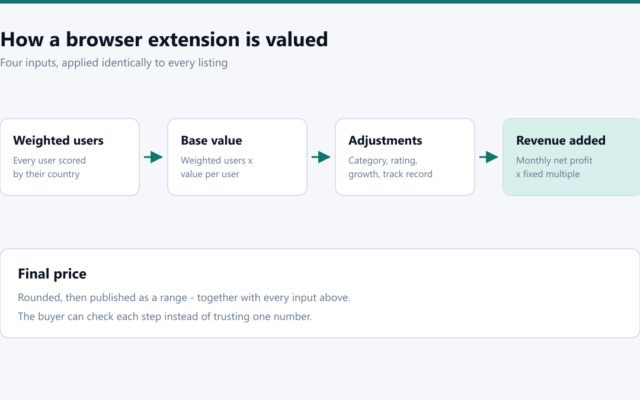
How to Value a Browser Extension: A Data-Driven Framework
Install counts alone tell you almost nothing. Here is the framework I use to value a browser extension, from weighting users by country to deciding what a revenue multiple should actually be.
4 min read
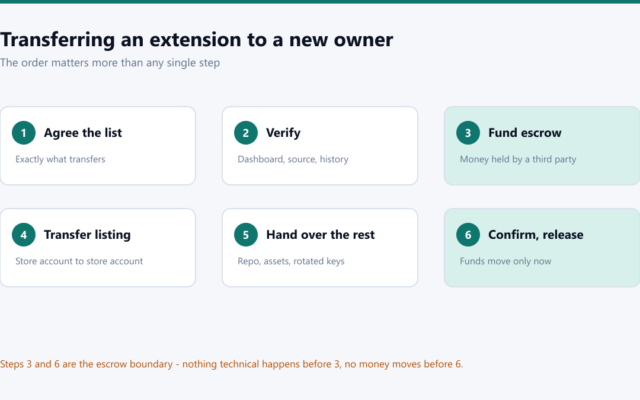
Chrome Web Store Ownership Transfer: A Step-by-Step Guide
Moving an extension to a new owner is the part of a sale that goes wrong most often. Here is the order the steps have to happen in, what breaks when you get it wrong, and how to protect both sides.
4 min read
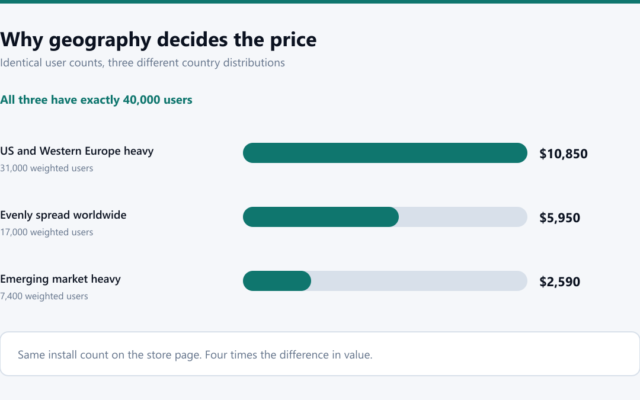
Why User Geography Decides What a Browser Extension Is Worth
Two extensions with identical install counts can differ fourfold in value. The variable that explains most of that gap is which countries the users are in, and it is measurable.