How to Value a Browser Extension: A Data-Driven Framework
Install counts alone tell you almost nothing. Here is the framework I use to value a browser extension, from weighting users by country to deciding what a revenue multiple should actually be.
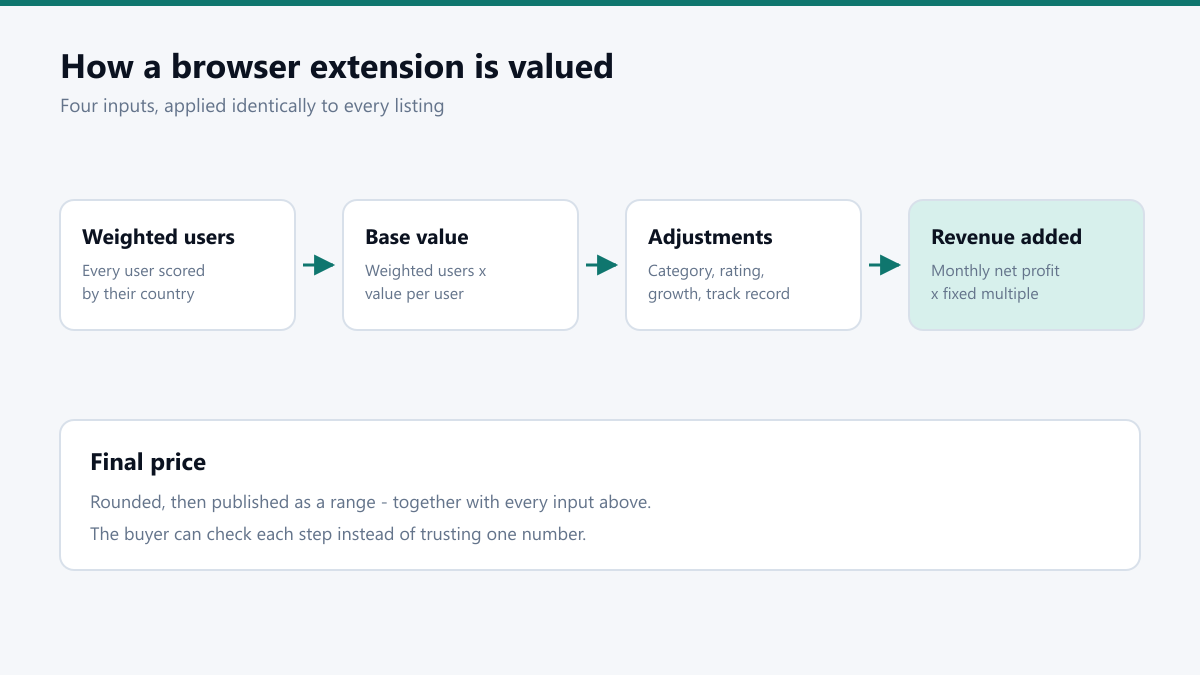
Ask three people what a browser extension is worth and you will get three numbers an order of magnitude apart. The reason is almost always the same: they are all looking at the install count and nothing else. A 50,000-user extension can be worth 40,000 dollars or 2,000 dollars, and the gap has very little to do with the 50,000.
This is the framework I use on every listing on this site. It is not the only defensible model, but it is written down, applied consistently, and shown on each listing to signed-in buyers so they can argue with it.
Start with weighted users, not raw users
The single largest determinant of value is where the users are. An extension user in the United States generates several times the advertising revenue, converts to a paid plan at a much higher rate, and sits inside a market where nearly every monetisation route is available. A user in a low-ARPU market may be just as engaged and just as loyal, and still be worth a fraction of that commercially.
So the first step is to throw away the headline number and rebuild it. Export the country breakdown from the developer dashboard, assign each country a weight, and multiply through. Ten thousand users concentrated in Germany and the Netherlands are not the same asset as ten thousand users spread across markets where nobody has ever paid for a browser extension.
The weights themselves are a judgement call and they should be. What matters is that you apply the same weights to every extension you value, so your numbers are at least internally consistent. A rough tiering that holds up in practice:
| Tier | Typical markets | Weight |
|---|---|---|
| 1 | United States | 1.00 |
| 2 | United Kingdom, Canada, Australia, Nordics, Switzerland | 0.85 |
| 3 | Germany, Netherlands, Japan, South Korea, Singapore, Gulf states | 0.60 |
| 4 | France, Italy, Spain, Central Europe, Chile, Taiwan | 0.42 |
| 5 | Brazil, Mexico, Turkiye, Russia, South Africa, Malaysia | 0.26 |
| 6 | India, Indonesia, Philippines, Vietnam, most of Africa | 0.14 |
Attach a base value to a weighted user
Once you have weighted users, you need a price for one of them. This is the number most people get wrong in both directions.
For an extension with no revenue at all, somewhere between 0.20 and 0.80 dollars per Tier 1 user is where real transactions tend to land. Below that you are giving away a working distribution channel. Above it you are asking a buyer to pay for a business that does not yet exist. I default to 0.35 and adjust from there.
The honest way to calibrate this is your own sales history. If three extensions in a row sell at 60 percent of your asking price, your base value is too high and no amount of arguing changes that.
Adjust for the things buyers actually pay for
After the base figure, a small number of multipliers do real work. Keep the list short. Every extra factor you add is another number you have to defend, and most of them are already priced into the ones below.
- Category demand. Privacy, security and shopping extensions convert to subscription or affiliate revenue far more readily than novelty ones. Same users, different ceiling.
- Store rating. A 4.7 with 900 reviews is a moat. A 3.4 is a warning that churn is coming and the buyer will inherit it. Weight the rating by review count, or a five-star average from six people will distort everything.
- Growth. A user base growing 15 percent a month is worth more than a flat one, but do not apply the raw monthly rate to an annual valuation. Half of it is plenty.
- Track record. Years live in the store is a genuine trust signal, and it caps out quickly. Three years and ten years are not meaningfully different to a buyer.
- Store diversification. An extension published only in one store is one policy decision away from zero. The same extension on four stores is a materially safer asset.
Add revenue separately, never multiply it
If the extension earns money, value that stream on its own and add it. Small digital assets trade somewhere in the 20x to 36x monthly net profit range, and 24x is a reasonable default for something with a short history.
The important part is that revenue gets added, not folded into the multipliers. If you multiply the revenue component by your quality and growth factors as well, you are counting the same signals twice: the rating and the growth are part of why the revenue exists in the first place.
Publish the working
The last step is not arithmetic. Whatever number you land on, show how you got there. A buyer who can see the calculation can check it, argue with one input, and come back with a counteroffer. A buyer who is handed a single number with no explanation usually just closes the tab.
Does the install count matter at all?
It matters as raw material, not as the answer. The install count is the input you weight by country and adjust by quality signals. On its own it tells you the size of the audience and nothing about what that audience is worth.
What if I have no country data?
Then value the users at a conservative blended weight and say so openly. Assuming a high-value distribution you cannot evidence is how sellers end up with listings that sit unsold for months. Export the country report first if you possibly can – it is a few clicks in every developer dashboard.
Should a non-monetised extension be worth anything?
Yes, and often quite a lot. What the buyer is purchasing is a distribution channel with users already in it, which is the expensive part of building any extension business. The absence of revenue is exactly why the price is based on users rather than a profit multiple.
How much does a bad rating really cost?
More than the multiplier suggests, because it comes with hidden churn. A rating under 3.5 with a meaningful review count usually means users are actively unhappy rather than merely indifferent, and the buyer inherits both the reviews and the reason for them.
Keep reading
4 min read
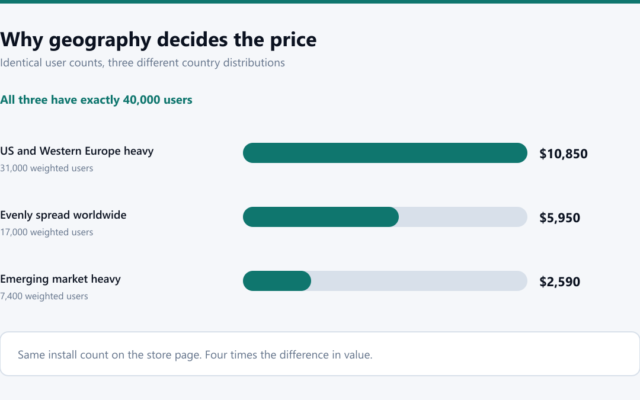
Why User Geography Decides What a Browser Extension Is Worth
Two extensions with identical install counts can differ fourfold in value. The variable that explains most of that gap is which countries the users are in, and it is measurable.
4 min read
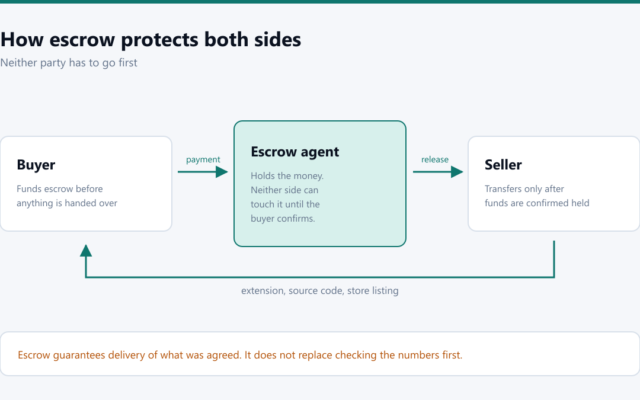
Buying a Browser Extension Safely: How Escrow Protects Both Sides
In a browser extension sale neither side can go first without exposure. Escrow removes that problem entirely, and understanding how it works is what separates a clean deal from a bad story.
4 min read
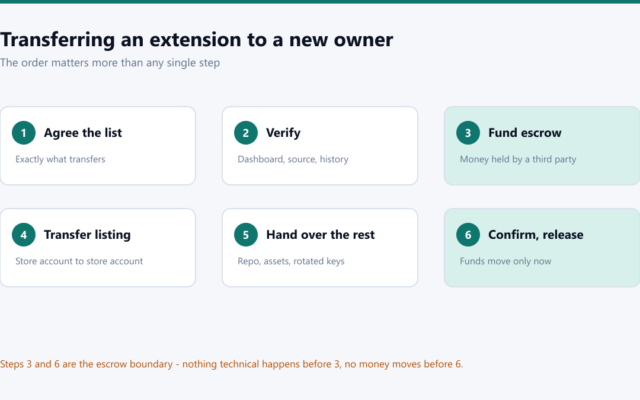
Chrome Web Store Ownership Transfer: A Step-by-Step Guide
Moving an extension to a new owner is the part of a sale that goes wrong most often. Here is the order the steps have to happen in, what breaks when you get it wrong, and how to protect both sides.